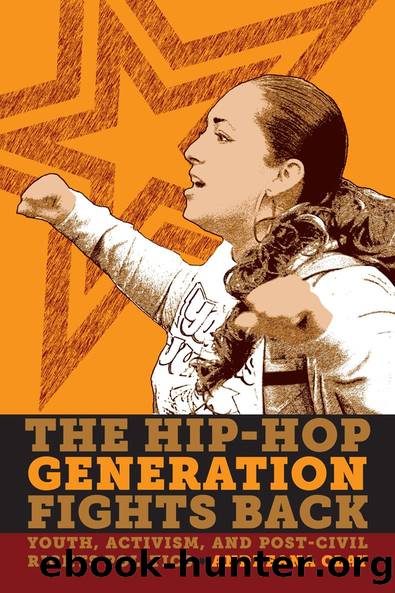
The Hip-Hop Generation Fights Back by Andreana Clay
Author:Andreana Clay [Clay, Andreana]
Language: eng
Format: epub
Tags: Social Science, General, Anthropology, Cultural & Social
ISBN: 9780814723951
Google: 73sqM6hldXAC
Publisher: NYU Press
Published: 2012-07-02T03:20:52+00:00
Conclusion
In this chapter, I have explored how youth use hip-hop as an organizing strategy in the twenty-first century. Specifically, we have seen how hip-hop culture becomes a tool that allows youth of color to transform their individual and organizational politics in their everyday lives. It is in these moments that hip-hop becomes the mechanism that youth utilize to make sense of their social location and social justice organizing. For the youth involved with Teen Justice, hip-hop culture was central in gaining support for the political issues that they were involved in. Organizers like Naseem, Conrad, David, and Eduardo explicitly view hip-hop as an important mobilizing tool with other teenagers. And, as Conrad indicates in his discussion of the political potential of hip-hop, poetry slams and other events got folks interested because âeveryone is listening.â Or, as David keenly observes, every generation has its moment and for postâcivil rights youth, the moment is informed by hip-hop.
While youth use hip-hop to organize around structural change in their communities, hip-hop also influence their individual political (race, class, and gender) identities. As Courtney and David explained, hip-hop was important for them because they were able to write and express the things that happened in their communities in a form that reflected those communities. Te and Donelle also cited Tupac and other rappers as a central to their individual understandings of their raced and gendered location as young Black males. In spite of the more commercialized aspects of hip-hop, which the youth themselves critique, the important position it has in the lives and experience of youth of color, make it an important organizing tool.
By reconceptualizing the importance of popular culture in the everyday practices and organizational strategies of marginalized groups, scholars can âprivilege the specific lived experience of distinct communities [and] also ⦠search for those interconnected sites of resistance from which we can wage broader politics.â37 For postâcivil rights youth, this is imperative in understanding their dual experience as both the subjects of history postâcivil rights as well as objects of civil rights history. This approach must be understood as central to analyzing the importance of popular culture, social movement processes, and social change in the postâcivil rights era.
Download
This site does not store any files on its server. We only index and link to content provided by other sites. Please contact the content providers to delete copyright contents if any and email us, we'll remove relevant links or contents immediately.
Cecilia; Or, Memoirs of an Heiress — Volume 1 by Fanny Burney(32562)
The Great Music City by Andrea Baker(32023)
Cecilia; Or, Memoirs of an Heiress — Volume 2 by Fanny Burney(31959)
Cecilia; Or, Memoirs of an Heiress — Volume 3 by Fanny Burney(31945)
We're Going to Need More Wine by Gabrielle Union(19053)
All the Missing Girls by Megan Miranda(16050)
Pimp by Iceberg Slim(14522)
For the Love of Europe by Rick Steves(14174)
Bombshells: Glamour Girls of a Lifetime by Sullivan Steve(14081)
Norse Mythology by Gaiman Neil(13376)
Talking to Strangers by Malcolm Gladwell(13376)
Fifty Shades Freed by E L James(13247)
Mindhunter: Inside the FBI's Elite Serial Crime Unit by John E. Douglas & Mark Olshaker(9347)
Crazy Rich Asians by Kevin Kwan(9297)
The Lost Art of Listening by Michael P. Nichols(7509)
Enlightenment Now: The Case for Reason, Science, Humanism, and Progress by Steven Pinker(7316)
The Four Agreements by Don Miguel Ruiz(6770)
Bad Blood by John Carreyrou(6626)
Weapons of Math Destruction by Cathy O'Neil(6284)
